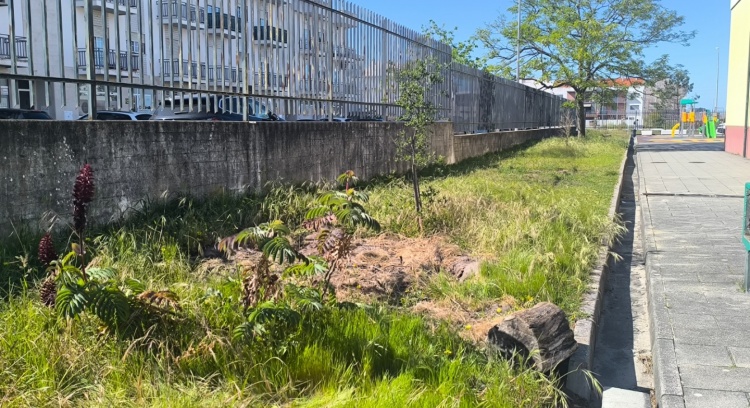
The campaign aims to recover and create green spaces in order to enhance student learning in a real and natural context.
Storm Kristin caused significant damage to the urban ecosystems of Marinha Grande and Leiria, significantly affecting the green spaces integrated into educational establishments. This reality created not only the need to recover destroyed natural areas, but also the opportunity to rethink the relationship between the school community and the environment, promoting new learning dynamics in a real-world context.
The implementation of microforests at the Nery Capucho Basic School, belonging to the Marinha Grande Nascente School Group (AEMGN), emerges as an ecological, educational, and community-based response, aligned with the Sustainable Development Goals (SDG 4 – Quality Education, SDG 11 – Sustainable Cities and Communities, SDG 13 – Climate Action, and SDG 15 – Life on Land). These microforests will simultaneously regenerate ecosystems, enhance active learning in context, and strengthen environmental citizenship practices.
The successful experience of implementing microforests, developed by and with the support of the Aga Khan Foundation, serves as a reference and model to be implemented in the three schools within our educational territory.
About the author
It resulted from the merger of the Prof. Alberto Nery Capucho School Group with the Pinhal do Rei Secondary School on April 24, 2013, encompassing Pre-School Education, Basic Education, and Secondary Education (Regular and Vocational). The Group is composed of several organic units:
|
Preschool Education
|
Basic
|
Secondary Education
|
|
1st Cycle of Basic Education
|
2nd Cycle of Basic Education
|
3rd Cycle of Basic Education
|
|
|
JI Boavista
JI Comeira
JI Engenho
JI João Beare
JI Pedrulheira
JI Picassinos
JI Pilado
JI Trout
|
EB Albergaria
EB Comeira
EB Engenho
EB João Beare
EB Nery Capucho
EB Picassinos
EB Pilado
EB Trout
|
EB Nery Capucho
|
EB Nery Capucho
ES Pinhal do Rei
|
ES Pinhal do Rei
|
The school group provides academic services to 2124 students from 28 different nationalities.
The diversity of the public, resulting from the city's multicultural growth, combined with the increase in compulsory schooling to 18 years of age, requires educational agents to develop strategies that contribute to solving problems related to school failure and dropout, promoting effective social inclusion.
The school cluster has essential technical and pedagogical resources and equipment that ensure the quality of student learning. It offers Special Education services, Psychology and Guidance services, and Speech Therapy services. The cluster has three libraries integrated into the School Libraries network (Nery Capucho, Pinhal do Rei and EB João Beare) and two Media Centers (EB Comeira and EB Engenho).
AEMGN is committed to an Inclusive School that aims to meet the diverse needs of students, where each one has the opportunity to find educational solutions according to their expectations and potential. Therefore, one of the major challenges is adapting teaching processes to the individual characteristics and conditions of each student, through the mobilization of support measures for learning and inclusion, and the provision of resources so that all students have access to the curriculum and learning opportunities.
AEMGN provides support to students with specific needs, distributed across different educational cycles, from preschool to the twelfth grade. The learning support center includes specialized support for multiple disabilities in the 3rd cycle of basic education and secondary education, and a similar service is being created for the 2nd cycle of basic education.
Budget and due dates
Technical Description of the Intervention
The intervention will be developed in four sequential technical stages: Building the dream, our microforest, planting execution, and monitoring and sustainability.
The planning phase includes mobilizing the educational community and defining the project vision. This is followed by species selection and ecological design, based on edaphic and climatic analysis. The execution phase comprises soil preparation, installation of a temporary irrigation system, and dense planting. Finally, technical support will be provided for a minimum period of 24 to 36 months.
5.1 Stage 1 – Building the Dream
- Mobilization of students, teachers, operational assistants and families.
- Gathering ideas and collaboratively defining the project vision.
- Involvement of partner entities from the initial phase.
5.2 Stage 2 – Our Microforest
- Identification and selection of native species adapted to the local climate and soil.
- Definition of the ecological design of the microforest.
- Technical support from the Parish Council's nursery, Quercus, and the Municipal Council's Environment Division.
5.3 Stage 3 – Execution and Planting
- Soil analysis: texture, depth, drainage, and organic content.
- Improving fertility through compost, biomass, and organic matter.
- Installation of an irrigation system for initial support.
- Dense and diverse planting, ensuring cooperation and symbiosis between species.
5.4 Stage 4 – Monitoring and Sustainability
- Monitoring for 24–36 months: humidity, weeds, plant replacement, irrigation system maintenance.
- Production of reports, photographic records, and field data by students.
- Promoting educational activities and events such as the "Forest Festival".
Prior to implementation, a soil analysis will be conducted, evaluating texture, usable depth, pH, drainage, and organic matter content. Based on the results, certified plant compost and structuring biomass will be incorporated.
Implementation and Budgeting Steps
The implementation of the microforest involves carrying out the steps indicated below, which allow for support and consultancy, the provision of training and capacity building for teachers and non-teaching staff, land preparation and application of irrigation systems whenever necessary, acquisition of species not available in the nursery, acquisition of equipment to support planting and maintenance.
|
Step
|
Description
|
Value
|
|
1
|
Consultancy
|
500 €
|
|
2
|
Information and Training
|
750 €
|
|
3
|
Preparation, Equipment and Planting
|
4,500 €
|
|
4
|
Maintenance
|
750 €
|
|
Total: €6,500
|
|
|
The estimated overall budget for implementing the microforest is €6,500, distributed across technical consultancy, capacity building, preparation and planting, as well as initial maintenance and equipment acquisition.
This investment ensures the correct technical execution of the microforest and its ecological viability in the medium and long term.
Contextualized learning activities provide students with the opportunity to acquire knowledge, skills, and attitudes that promote meaningful learning through immersive experiences connected to real-life situations. These activities can include field trips to natural or cultural spaces, hands-on workshops led by experts, research projects on the surrounding environment, participation in community initiatives, and the use of active learning methodologies such as problem-based learning or solving real-world challenges in the school and community.
The coordination of activities will be ensured by a working group made up of teachers, students, non-teaching staff, parents and guardians, as well as partners from the territory. This group will be responsible for defining an activity plan centered on the microforest as a living learning laboratory, promoting interdisciplinary approaches in the various areas of the curriculum.
The creation of workstations throughout the microforest will allow for the development of research activities, investigative work, and projects, involving disciplines such as Portuguese, Mathematics, Natural Sciences, English, Physical Education, and Artistic Expression.