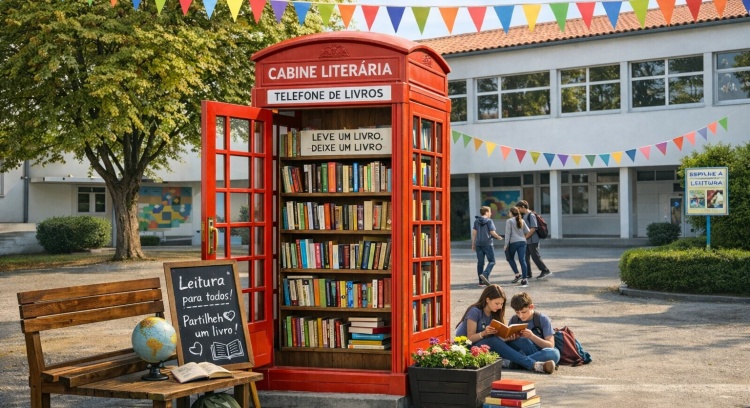
This project aims to implement thirteen reading booths in AEMGN educational establishments, specifically in the pre-school and primary education network, promoting reading as a daily practice accessible to all.
The school library plays a central role in the development of literacy skills, critical thinking, creativity, and active citizenship, constituting a privileged space for access to knowledge, culture, and inclusion.
In parallel, encouraging reading should extend beyond the physical limits of the school library, reaching outdoor spaces and the daily life of the educational community. The placement of reading booths—small, accessible, inclusive, and open structures—in the schools of the school district constitutes an effective strategy to promote informal reading, book sharing, and practices of cultural citizenship.
The essence of the literary booths will be a social catalyst aimed at transforming a physical object (often repurposed old telephone booths) into a point of free exchange; the library ceases to be a static building and becomes a living organism within the community.
This project aims to implement thirteen reading booths in the educational establishments of the Marinha Grande Nascente School Group (AEMGN) , in the pre-school and 1st cycle of basic education network, promoting reading as a daily, cross-curricular and accessible practice for all, in alignment with the Sustainable Development Goals, namely:
- SDG 4 – Quality Education
- SDG 10 – Reduced Inequalities
- SDG 11 – Sustainable Cities and Communities
- SDG 17 – Partnerships for the Goals
Scientific and Technical Basis
Scientific and pedagogical research demonstrates that regular access to books and stimulating reading environments has a direct impact on academic success, language development, reading comprehension, and a lifelong love of learning.
The literary booths, inspired by the concept of book crossing , promote spontaneous reading, intergenerational sharing, and a sense of belonging, reinforcing the library as a public service that is close to the school community and to culture.
1. Democratization and Proximity
The booth eliminates the "door barrier." Many people feel intimidated by formal libraries; the booth, being in the schoolyard, encourages handling without bureaucracy, registration forms, or rigid deadlines.
2. The BookCrossing Cycle
The concept rests on three pillars that strengthen civic engagement:
- To set free: To leave a book so that others may find it.
- Share: Allow knowledge to circulate free of charge.
- Taking care: Maintaining the space depends on collective respect, generating that sense of belonging.
3. Intergenerational Dialogue
It is common to see different types of people mixing in these spaces:
- The student who leaves behind a comic strip.
- A senior citizen sharing a classic novel or a memoir.
- This flow creates an invisible link between different ages through the stories that are passed from hand to hand.
4. Cultural Sustainability
Beyond encouraging reading, there's a circular economy aspect to it. A book sitting on a shelf is a dead object; in the booth, it gains a "second life" and promotes more conscious cultural consumption.
About the author
It resulted from the merger of the Prof. Alberto Nery Capucho School Group with the Pinhal do Rei Secondary School on April 24, 2013, encompassing Pre-School Education, Basic Education, and Secondary Education (Regular and Vocational). The Group is composed of several organic units:
|
Preschool Education
|
Basic
|
Secondary Education
|
|
1st Cycle of Basic Education
|
2nd Cycle of Basic Education
|
3rd Cycle of Basic Education
|
|
|
JI Boavista
JI Comeira
JI Engenho
JI João Beare
JI Pedrulheira
JI Picassinos
JI Pilado
JI Trout
|
EB Albergaria
EB Comeira
EB Engenho
EB João Beare
EB Nery Capucho
EB Picassinos
EB Pilado
EB Trout
|
EB Nery Capucho
|
EB Nery Capucho
ES Pinhal do Rei
|
ES Pinhal do Rei
|
The school group provides academic services to 2124 students from 28 different nationalities.
The diversity of the public, resulting from the city's multicultural growth, combined with the increase in compulsory schooling to 18 years of age, requires educational agents to develop strategies that contribute to solving problems related to school failure and dropout, promoting effective social inclusion.
The school cluster has essential technical and pedagogical resources and equipment that ensure the quality of student learning. It offers Special Education services, Psychology and Guidance services, and Speech Therapy services. The cluster has three libraries integrated into the School Libraries network (Nery Capucho, Pinhal do Rei and EB João Beare) and two Media Centers (EB Comeira and EB Engenho).
AEMGN is committed to an Inclusive School that aims to meet the diverse needs of students, where each one has the opportunity to find educational solutions according to their expectations and potential. Therefore, one of the major challenges is adapting teaching processes to the individual characteristics and conditions of each student, through the mobilization of support measures for learning and inclusion, and the provision of resources so that all students have access to the curriculum and learning opportunities.
AEMGN provides support to students with specific needs, distributed across different educational cycles, from preschool to the twelfth grade. The learning support center includes specialized support for multiple disabilities in the 3rd cycle of basic education and secondary education, and a similar service is being created for the 2nd cycle of basic education.
Budget and due dates
Implementation and Budgeting Steps
The installation of the book booths presupposes the definition of the model and its production with the support of the entity invited to budget the basic model, the development of promotional activities with supervision from the Group's library network, monitoring and sustainability of the project. The estimated cost for the thirteen booths is €15,600.
|
Step
|
Description
|
Value
|
|
1
|
Construction and Installation of Book Booths
|
1000€
|
|
2
|
Acquisition of the literary collection
|
200€
|
|
Total: €15,600
|
|
|
Technical Description of the Intervention
The implementation of a book booth in a school setting should be viewed as a collaborative project involving students, teachers, and the surrounding community. For the project to be sustainable, the process can be divided into four main phases:
Phase 1: Planning and Mobilization
In this initial stage, the project structure is defined and the necessary support is gathered:
- Creating the Management Team: Involve the school library, the eco-school council, and student representatives.
- Choosing the Location: Identify a strategic point on the school grounds that is easily accessible but protected from the elements.
- Collection of Structures: Decide whether an old telephone booth will be restored, a new structure will be built with recycled materials, or a cabinet/display case will be adapted.
Phase 2: Preparation and Visual Identity
Here, the booth takes shape and the students become the protagonists through artistic expression:
- Rehabilitation and Painting: Visual arts workshops to decorate the cabin, reinforcing the students' sense of belonging.
- Signage and Rules: Create simple posters with the project slogan ("Take, Read, Return" or "Bring one, Take another") to explain how it works to the community.
- Initial Curation: Select a small batch of appealing books from various genres to inaugurate the space.
Phase 3: Inauguration and Launch
The time has come to introduce the project to everyone:
- Opening Event: A symbolic ceremony, perhaps with a public reading or a musical performance, inviting parents and local partners.
- Donation Campaign: Launch a challenge to the school community for the first large book drive, ensuring the booth starts with a varied stock.
- Appointment of "Guardians": Delegating to students from different classes the weekly responsibility of checking the organization of the cabin.
Phase 4: Dynamization and Evaluation
To ensure the project doesn't lose momentum after the initial enthusiasm:
- Regular Activities: Promote "storytelling hours" next to the booth or bookmark contests.
- Monitoring Turnover: Assessing whether books are circulating or if the stock needs to be replenished with new donations.
- Community Expansion: If the booth is in a publicly accessible location, encourage neighbors and senior citizens in the area to participate in the literary exchange.